



Tobacco Free Initiative


Arabic web site

Search

Facts and FAQs

Some of the most prevalent tobacco health hazards and often obscured realities are supported through this section of FACTS & FAQS.

FACTS

  1. Tobacco: a problem for everyone

  2. Tobacco: a killer epidemic

  3. Tobacco use: patterns of mortality

  4. Smoking: a shorter life-span

  5. Tobacco products: a highly addictive commodity

  6. Harmful substances: a need for control

  7. Tobacco advertising: a key for the tobacco industry

  8. Health warnings: a form of public education

  9. Quitting: a healthier life at your constant disposal  

Fact 1 Tobacco: a Problem for everyone

Many people smoke and are therefore at risk of developing tobacco-related diseases. Those who do not smoke have colleagues, friends or relatives who do, and they risk prematurely losing a friend or relative to a tobacco-related disease. The preventable premature death of millions of well-trained and well-experienced people in their most productive middle years is a collective loss that transcends national boundaries. Many non-smokers suffer from involuntary exposure to tobacco smoke and also risk developing tobacco-related diseases. Such a broad-based problem requires broad-based solutions, involving many sectors of society.

Fact 2  Tobacco: a killer epidemic

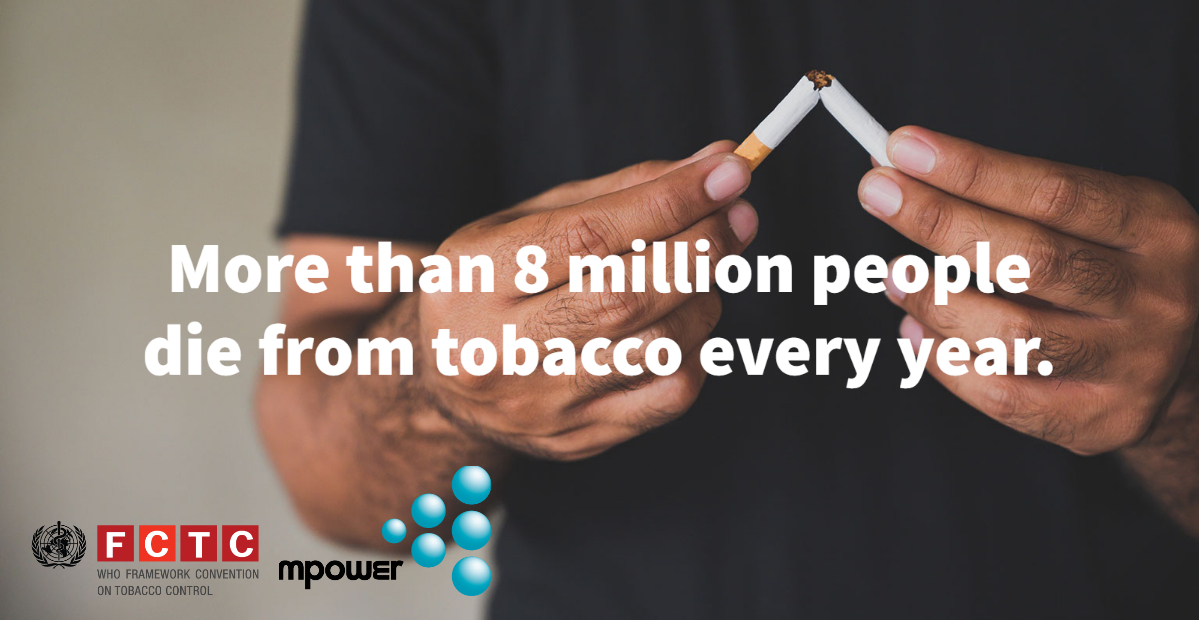
A long-term tobacco user has a 50% chance of dying prematurely from tobacco-related diseases. Each year, tobacco causes some five million premature deaths, with one million of these occurring in countries that can least afford the health-care burden. This epidemic was predicted to kill 250 million children and adolescents who are alive today, a third of whom live in developing countries.  

Current trends show that by the year 2020/2030, tobacco is likely to be the world’s leading cause of death and disability, killing more than 10 million people annually (70% of these deaths occurring in developing countries) and claiming more lives than HIV, tuberculosis, maternal mortality, motor vehicle accidents, suicide, and homicide combined. According to WHO estimates, there are approximately 1.1 billion smokers in the world - about one-third of the global population aged I5 years and over.  

Tobacco is a risk factor for some 25 diseases and while its effects on health are well-known, the sheer scale of its impact on the global disease burden may still not be fully appreciated. No single disease is expected to make such a giant claim on health as this one risk factor.  

Estimates indicate that tobacco is already responsible for about 2.6% of the total death and disease burden, and that it is projected to triple its share to 8.9% of the total by the year 2020. For each 1,000 tons of tobacco produced, about 1,000 people will eventually die. 

In the more developed countries, the impact of tobacco on the health of men is being manifested at present, although it has yet to reach its peak among women. The epidemic is only now beginning in low and middle-income countries; the biggest and sharpest increases in the disease burden are expected in China and India, where the use of tobacco has grown most steeply. If current trends continue, two to three million annual tobacco-related deaths are predicted for China alone by the 2020s. 

In the Eastern Mediterranean Region, we are not far from this. In Egypt alone, 90% of lung cancer deaths are attributed to tobacco use. In general, tobacco-related cancers as a percentage of all cancers are on the rise. Among men, the proportion rose from 8.9% to 14.8% between 1974 and1987.

Fact 3 Tobacco use: patterns of mortality

Despite widespread knowledge of the harm caused by smoking, only modest success has been achieved in global tobacco control. Worldwide consumption of manufactured cigarettes more than doubled from 1967 to 1992, from 2.8 trillion (2.8 million million) to 5.7 trillion (5.7 million million) cigarettes, with per capita cigarette consumption increasing by 25% during the same period.

In developed countries, where smoking became widespread during the 1940s and 1950s, the effects of past smoking trends can now be seen. Almost 20% of all deaths in the 1990s in developed countries are due to tobacco products. In the 35-69 year age group, about 35% of deaths among men and 15% among women are caused by tobacco. Although smoking rates have generally declined among adults in developed countries, they have risen in developing countries.

Fact 4 Smoking: a shorter life-span

The risk at the individual level is extremely alarming. Based on current data, life-long smokers, on average, have a 50% chance of dying from tobacco. And half of these smokers will die during their middle-ages (before the age of 70). Smokers who die from smoking before age 70 will loose, on average, 22 years of normal life expectancy.

Of all the diseases causally associated with smoking, lung cancer is the best known. However, smoking actually causes more deaths from diseases other than lung cancer. In 1995, there were 514,000 smoking-related lung cancer deaths in developed countries, compared to 625,000 smoking-attributable deaths from heart and other vascular diseases in the same year. Studies in the United Kingdom have shown that smokers in their 30s and 40s are five times more likely to have a heart attack than non-smokers.

Fact 5 Tobacco products: a highly addictive commodity

All tobacco products contain substantial amounts of nicotine, which is absorbed readily from tobacco smoke in the lungs and from smokeless tobacco in the mouth or nose. Nicotine has been clearly recognized as a drug of addiction, and tobacco dependence has been classified as a mental and behavioral disorder according to the WHO International Classification of Diseases, lCD-l0 (Classification F17.2).

Experts in the field of substance abuse consider tobacco dependence to be as strong or stronger than dependence on such substances as heroin or cocaine. Smoking typically begins in adolescence; if a person remains smoke-free throughout adolescence, it is highly unlikely that he or she will ever begin smoking. Therefore, it is vital that intensive efforts be made to help young people stay smoke-free.

Although 75%-85% of smokers, where this has been measured, want to quit and about one-third have made at least three serious attempts, however, less than half of smokers succeed in stopping permanently before the age of 60. Nicotine dependence is clearly a major barrier to successful cessation.

All tobacco products are carefully designed to undermine efforts to quit using them. Therefore, quitting is not simply a matter of choice for the majority of tobacco users. Instead, it involves a struggle to overcome an addiction.

Tobacco use typically is woven into everyday life, and can be physiologically, psychologically and socially reinforcing. Many factors combine with tobacco’s addictive capacity to make quitting difficult, including media depictions and cultural and societal acceptance of tobacco use.

More information

Fact 6 Harmful Substances: A Need for Control

It has been said that smoking low-tar cigarettes is a stage in the process of stopping smoking. WRONG. It has been contended that low-tar, low-nicotine cigarettes encourage young people and women to start smoking and may influence smokers to continue, in the belief that such cigarettes are less dangerous. Evidence presented in the tobacco industry’s suit challenging the Canadian Tobacco Products Control Act indicates that smoking low-tar cigarettes may in fact prevent people from stopping smoking as indicated by the following quotations:

“The desire to quit smoking altogether and the rationalization offered by many consumers that their going down in tar and nicotine brings them closer to the inevitable step of giving up smoking may actually increase the market considerably”. (Excerpt from document prepared by Marketing Systems, Inc for Imperial Tobacco Ltd. Exhibit AG-40).

“We have evidence of virtually no quitting among smokers of those brands (low tar and nicotine) and there are indications that the advent of ultra-low tar cigarettes has actually retained some potential quitters in the cigarette market by offering them a viable alternative”. (Excerpt from “The Response of the Market and of Imperial Tobacco to the Smoking and Health Environment”, Imperial Tobacco Ltd. Exhibit AG-41).

Fact 7 Tobacco advertising: a Key for tobacco industries

The importance of advertising to the tobacco industry is reflected in the size and growth of expenditure for this purpose. In 1978, global advertising costs of the transnational conglomerates amounted to US$1.8 billion (United Nations, 1978). A decade later in 1988, in the USA alone, the tobacco industry spent US$3.27 billion in advertising and promotion – nearly double its global expenditure in 1978 and an increase of 26.9% over its US expenditure in 1987. From 1975 to 1988, total cigarette advertising and promotional expenditure increased more than six-fold and, when adjusted by the consumer price index to constant 1975 dollars, increased three-fold (Centers for Disease Control and Prevention, 1990a).

The enormous amounts spent by the multinational tobacco companies worldwide on the sponsorship of sports and cultural events – a form of promotion that associates tobacco with healthy and pleasurable pursuits – are not known. Such sponsorship reaches not only the audience attending the events but also the vast audiences, many of them children and adolescents, who watch them on television. In recent years, the industry has been increasing its expenditure on sponsorship. From 1980 to 1983 in the USA, total advertising expenditure rose by 30%, but promotional expenditure nearly doubled (Warner, 1986a).

Sponsorship support, including newspaper and billboard advertising of the event, is generally thought to require expenditure equal to that spent on sponsorship itself. To give some idea of the order of magnitude of expenditure on sponsorship, in 1988 in the USA, cigarette advertising and promotional expenditure related to the sponsorship of sports events amounted to US$84 million (Centers for Disease Control and Prevention, 1990a). In 1990, the Philip Morris Companies spent US$15 million in the USA on sponsorship of the arts alone (Rothstein, 1990).

Fact 8 Health warnings: a form of public education

Mandatory health warnings and indications of tar and nicotine content on cigarette packages and tobacco advertising are a form of health information aimed at alerting the public to the dangers of smoking and use of tobacco. The reasons for this type of legislation are as follows:

  • To alert the public to the health hazards of tobacco use.

  • To serve as the basis or starting point for a health education program.

  • To put the weight of the government and the health authorities behind a smoking-control policy and thus to assist the movement towards a smoke-free society.

These reasons for mandatory health warnings in advertising and for labels to provide information on the content of harmful substances have become more compelling as rotating warnings and other innovations in the presentation of warnings have provided more effective messages.

But, health warnings cannot, of course, be a substitute for a comprehensive health education program for children or for public information for the people as a whole. Such warnings can, however, serve to reinforce educational programs.

Nor should the statement of tar and nicotine content and carbon monoxide yield imply that cigarettes with low tar, nicotine or carbon monoxide yields are safe. For some time, evidence has been available that smokers of low-yield cigarettes do not consume less nicotine because they tend to compensate for the reduction in yield by increasing the number of cigarettes smoked (Benowitz et al., 1983; Maron & Fortmann, 1987).

Fact 9 Quitting: a healthier life at your constant disposal

Smoking cessation has immediate and substantial health benefits and dramatically reduces the risk of most smoking-related diseases. One year after quitting, the risk of coronary heart disease decreases (CHD) by 50%. Within 15 years, the relative risk of dying from CHD for an ex-smoker approaches that of a lifetime non-smoker.

Moreover, the relative risks of developing lung cancer, chronic obstructive lung diseases and strokes also decrease, but more slowly. Ten to fourteen years after smoking cessation, the risk of mortality from cancer decreases to nearly that of those who have never smoked. Smoking cessation also shows a beneficial effect on pulmonary function, particularly in younger subjects, and the rate of decline among former smokers returns to that of those who have never smoked.

Recent evidence shows that ceasing before the age of 35 is of greater benefit than ceasing at a later time, but there are still substantial benefits, no matter at what age one quits tobacco use.

No amount of tobacco use is safe. Abstinence from tobacco products and freedom from exposure to second-hand smoke are necessary for maximizing health and minimizing risk. Effective treatment for tobacco dependence can significantly improve overall public health within only a few years.

Remember, there are many benefits to quitting smoking.

FAQS

  1. What are the diseases caused by tobacco Use?

  2. Is smoking a free choice?

  3. Are we killing our children with smoke?

  4. How credible are the tobacco industry’s youth anti-smoking campaigns?

  5. Why should we discourage youth from smoking?

  6. Why must we restrict sales to adults?

  7. Why are comprehensive tobacco control measures necessary?

  8. How do we create tobacco-free health services?

  9. How do you kick the habit?

Question 1 What are the diseases caused by tobacco use?

Smoking is a known or probable cause of deaths from cancers of the oral cavity, larynx, lung, oesophagus, bladder, pancreas, renal pelvis, stomach, and cervix. Smoking is also a cause of heart disease, strokes, peripheral vascular diseases, chronic obstructive lung diseases and other respiratory diseases, and low-birth weight babies. Moreover, smoking is a probable cause of peptic ulcer diseases, unsuccessful pregnancies, and increased infant mortality including sudden infant death syndrome (SIDS).

More information

Question 2 Is smoking a free choice?

Nearly all smokers take up the habit of smoking or tobacco use when they are very young. Quickly, they become addicted to the product without even realizing. At such a young age, it would be impossible for the smoker to know all the tobacco use health hazards and the risks which he/she is taking by not stopping. In one of the Pan-American Health Organization’s fact sheets for the "2000 World No Tobacco Day", the following facts were published:

In developing countries, many smokers are unaware of the risks of tobacco use. For example, a study in China showed that most smokers thought smoking did them little or no harm.

Even in developed countries, smokers and the population in general are unaware of many of the risks of smoking. Smokers tend to under-estimate the risks of smoking on their health or fail to internalize the risks.

Most smokers are unable to name a disease other than lung cancer that is caused by smoking, and most smokers rate their own chances of developing a smoking-related disease as less than, equal to, or only slightly greater than "the average person". Most smokers are unaware that smoking causes more deaths than car accidents.

Many smokers think "low-tar" cigarettes reduce their risks of illness from smoking, but studies show that these cigarettes are just as harmful as regular cigarettes because smokers smoke them differently to get more nicotine and, as a consequence, get more tar.

Question 3 Are we killing our children with smoke?

YES. The children of parents who smoke have an increased frequency of respiratory and middle-ear infections, and are at risk of impaired lung function. Passive smoking/environmental tobacco smoke (ETS) is also a cause of additional episodes and increased severity of symptoms in asthmatic children.

Babies born to women who smoke during pregnancy, as well as those infants exposed to ETS have a much greater risk of dying of sudden infant death syndrome. Children exposed to ETS:

Suffer more coughs and colds as well as lower respiratory tract infections such as bronchitis and pneumonia.

Have an increased chance of developing asthma, triggering off or making existing asthma worse.

Have an increased risk of developing middle-ear infections which can lead to reduced hearing.

Are at an increased risk of lymphoma (cancer of white blood cells) and brain tumors during childhood.

Moreover, in a study, it was found that twice as many children of smokers say that they want to smoke compared to children of non-smokers. When a parent smokes, the child will consider smoking to be an adult behavior and he/she will want to take up the habit as soon as they can.

Therefore, the choice is yours. You either want to grant your children the chance to live or license them to die.

More information

Question 4 How credible are the tobacco industry’s youth anti-smoking campaigns?

In many countries, cigarette advertising links smoking with being cool, taking risks and growing up. At the same time, the tobacco industry insists that it does not want children to smoke.

These statements have recently been backed up with campaigns which are supposedly designed to discourage young people from smoking. But programmes like "Tobacco: helping youth say no" are not only slick public relations efforts designed to bolster industry credibility, they actually encourage youth to use tobacco.

By leaving out the health dangers, ignoring addiction and glamorizing smoking as an "adult custom", these campaigns reinforce the industry’s advertising theme that presents smoking as a way for children to exert independence and be grown up.

More information   

Question 5 Why should we discourage youth from smoking?

To decrease morbidity and mortality from diseases caused by smoking among young people for whom the risk increases the longer they smoke.

To prevent the onset of smoking among adolescent girls in order to avoid the special risks to women; for women using oral contraceptives, smoking increases the risk of heart attacks; women who smoke are at an increased risk of cervical cancer, and smoking during pregnancy increases the risk of miscarriage and has damaging effects on the fetus.

To prevent smoking by young adults who are parents, in view of the evidence that smoking by parents is detrimental to the health of children both by exposing them to tobacco smoke and by influencing their smoking habits.

To prevent the development of tobacco dependence in the most vulnerable group of the population: young people.

Question 6 Why must we restrict sales to adults?

To discourage adults from smoking.

To reinforce legislation restricting smoking in public places and the workplace.

To keep hospitals free from smoke for the sake of patients whose condition may be adversely affected by it, and to reinforce the message about the benefits obtained from not smoking for patients and their visitors at a time when they are particularly health-conscious.

To contribute to a smoke-free atmosphere in educational institutions and public buildings and thus to convey a strong educational message on smoking and health.

To promote the development of a smoke-free society.

Question 7 Why are comprehensive tobacco control measures necessary?

Cooperation between different sectors is necessary to bring about change. There is a general agreement that prevention is an important component of tobacco control. Therefore, children should be taught about the dangers of tobacco use and they will subsequently make the decision to refrain from its use. Problem solved, RIGHT?

WRONG. Unfortunately, the situation is much more complicated. In many countries, the serious consequences of tobacco use are largely unknown. But even where health education campaigns have had successes in informing the public, and particularly children about the dangers of tobacco, it is not enough.

We say we do not want our children to smoke and we offer them health education programmes to reinforce this message; this may lead them to a decision to remain smoke-free. However, this decision is often challenged at every opportunity when the social environment actually condones and even glamorizes the use of tobacco. The following is not such an unlikely scenario:

Imagine a child who has just received the finest in health education programming. This child has barely to leave the schoolyard when his/her attention is drawn to a huge billboard luring him/her to the land of cigarette-smoking cowboys.

Once at home, he/she turns on the television and there is a cigarette commercial. He/she flips through a magazine and is faced with the same images.

The next day, the child notices posters advertising a major rock concert sponsored by a tobacco company. The price of admission is only two empty cigarette packs. Luckily, a nearby vending machine stands ready to sell him/her the required brand and at a price within his/her budget.

Before too long, he/she is smoking regularly and we wonder how this could have happened!

This example reinforces the fact that a partial solution to a major problem is not enough. Tobacco control must come from all sectors and it must be comprehensive in scope. The following, derived from World Health Assembly resolutions, along with recommendations from other international and intergovernmental bodies lists some key elements that should be included in comprehensive national tobacco control programmes.

A 10-point programme for successful tobacco control:

  1. Protection for children from becoming addicted to tobacco.

  2. Use of fiscal policies to discourage the use of tobacco, such as tobacco taxes that increase faster than the growth in prices and income.

  3. Use a portion of the money raised from tobacco taxes to finance other tobacco control and health promotion measures.

  4. Health promotion, health education and smoking cessation programmes. Health workers and institutions set an example by being smoke-free.

  5. Protection from involuntary exposure to passive smoking/environmental tobacco smoke (ETS).

  6. Elimination of socio-economic, behavioral and other incentives which maintain and promote use of tobacco.

  7. Elimination of direct and indirect tobacco advertising, promotion and sponsorship.

  8. Controls on tobacco products, including prominent health warnings on tobacco products and any remaining advertisements; limits on and mandatory reporting of toxic constituents in tobacco products and tobacco smoke.

  9. Promotion of economic alternatives to tobacco growing and manufacturing.

  10. Effective management, monitoring and evaluation of tobacco issues.

Many of these elements extend beyond the domain of the health sector; therefore, real progress in tobacco control cannot occur without the involvement of other sectors. It is not sufficient for tobacco control to be merely a top public health priority; it is, and must be seen as a top public policy priority.

Question 8 How to create tobacco-free health services?

By 1993, many countries worldwide have passed laws or regulations to prohibit or restrict smoking in health facilities. Smoking by health personnel, that is, smoking in health facilities such as workplaces is also restricted in many countries. Selling tobacco in health premises is prohibited only in a few countries.

However, besides this legislative action, tobacco-control activities of physicians and other voluntary moves by individual hospitals are also particularly important. The following elements are essential to achieve tobacco-free health services:

  • Tobacco-free policies should be discussed, decided and implemented with the full participation of employees.

  • Employers in tobacco-free health services should assist smokers with appropriate information and cessation programmes. The patients should follow cessation support services as an integral part of treatment particularly for tobacco-related diseases.

  • The policies should be carefully followed-up and evaluated at regular intervals and, if necessary, re-oriented.

  • Promoting tobacco-free health services is easier to succeed when integrated into a more general community (or national) based tobacco control movement or campaign.

    More information

Question 9 How to kick the habit?

Determination in the answers.

(For practical steps)


1

What are the diseases caused by tobacco use?


2

Is smoking a free choice?


3

How credible are the tobacco industry’s youth anti-smoking
campaigns
?


4

How credible are the tobacco industry’s youth anti-smoking
campaigns
?


5

Why should we discourage youth from smoking??


6

Why must we restrict sales to adults?


7

Why are comprehensive tobacco control measures necessary?


8

How do we create tobacco-free health services?


9

How do you kick the habit?