|
|
News and events
Meetings
Back
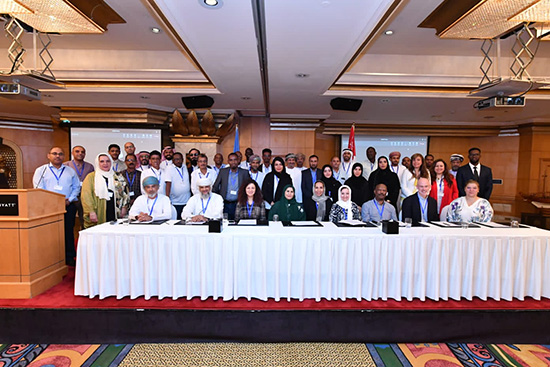
Fifth Inter-Country Meeting
of National Malaria Programme Managers
Countries Free from Malaria with Residual Transmission
Damascus, Syrian Arab Republic, 21-23 June 2005
In the Name of God, the Compassionate, the
Merciful
Message from
DR HUSSEIN A. GEZAIRY
REGIONAL DIRECTOR
WHO EASTERN MEDITERRANEAN REGION
Distinguished Guests, Dear Colleagues, Ladies and Gentleman,
It gives me great pleasure to welcome you all to the Fifth Intercountry
Meeting of the Roll Back Malaria (RBM) National Programme Managers for
countries free from malaria or with residual foci.
Let me first thank His Excellency Dr Maher Al Hossamy, Minister of Health,
for his commitment to the health of the people in his country and to
congratulate him on the accomplishments in the fight against malaria in the
Syrian Arab Republic . I wish to acknowledge the commendable efforts made by
the malaria control staff which have relieved the Syrian Arab Republic from,
what was in the past, a great problem with malaria. I am pleased to know
that the Syrian Arab Republic is on the last step towards interrupting local
transmission, with only one local case having been reported in 2004, in
Malekia Province . Let us focus on strengthening our efforts together in the
coming 3 years to reach complete elimination.
Ladies and Gentlemen,
As you may know, 3 May 2005 saw the launching simultaneously in Cairo , New
York and Geneva of the first World Malaria Report, which was developed by
the World Health Organization (WHO) and the United Nation’s Children’s Fund
(UNICEF). This report summarizes the status of malaria world-wide. It
demonstrates that malaria is still a major global problem, exacting an
unacceptable toll on the health and economic welfare of the world’s poorest
communities. At the end of 2004, 107 countries and territories had areas at
risk of malaria transmission where about 3.2 billion people live. An
estimated 350 million to 500 million clinical malaria episodes, and more
than 1 million deaths, occur each year. At the same time, the report clearly
shows that there is some progress towards effective treatment and prevention
of malaria. More countries are adopting effective drugs, in the form of
artemisin-based combination therapies, or ACTs, as their first line
treatment for falciparum malaria.
Dear Colleagues,
You will recall that the inception of Roll Back Malaria in the Eastern
Mediterranean Region took place in Cairo in 1999, when all malaria-endemic
countries adopted the RBM initiative and committed themselves to halving the
burden of malaria by 2010. In addition to the global objective, the Eastern
Mediterranean Region adopted supporting efforts for elimination of malaria
in all areas where it was considered feasible, and for preventing
reintroduction of malaria to countries which had been freed from it. Within
this commitment, malaria elimination was achieved recently in the United
Arab Emirates and Oman and will very soon be attained in Egypt , Morocco and
the Syrian Arab Republic . Additionally, Islamic Republic of Iran, Iraq and
Saudi Arabia , which were classified as of low to moderate malaria
endemicity, have already changed, or will change in the very near future,
the objective of the malaria programme from control to elimination, as a
result of the progress made in control.
Our vision in the Region is expand the malaria-free areas, to create, for
example, a malaria-free North Africa and a malaria-free Arabian Peninsula .
In this respect, we are trying to establish a strong partnership with all
Gulf Cooperation Council countries to ensure sustained support to the
programme in the Republic of Yemen . It is imperative that we all understand
that the more malaria is controlled in neighbouring countries, the more we
protect ourselves and preserve our malaria-free status. Thus, I would like
to request your help in extending further the generous technical and
financial support you have already given to neighbouring countries where
malaria still exists and still presents a problem.
Ladies and Gentlemen,
As you know, your countries, which have been freed from malaria, are
nevertheless still receptive to malaria and face the challenge of
expatriates from malaria-endemic countries. Without vigilance, there is a
threat of reintroduction of malaria. In this regard, the Regional Office has
made an effort to update the strategy for prevention of malaria
reintroduction and elimination of residual foci. Such issues were discussed
during the informal consultation that was held in Rabat , Morocco in June
2002. Currently, the Regional Office is working together with WHO
headquarters to establish a methodology of certification of malaria-free
status, which is being tested in the United Arab Emirates .
I would like to emphasize the importance of a strong malaria surveillance
system to ensure early detection of cases, and the need for immediate
treatment with the effective drug. As you know, the data available from all
countries with falciparum malaria shows that resistance to chloroquine is
widespread and it is no longer effective. Over 40 countries have already
revised their malaria treatment policy to include ACT. This reality should
be considered in updating your treatment policy and advising on the drugs to
be used for chemoprophylaxis of travellers to endemic countries.
I wish to remind you that malaria microscopy is still the gold standard for
malaria diagnosis and ensuring its quality is of utmost importance. The
rapid diagnostic test is complementary and can be used for case finding in
certain situations, but the blood slides should still be taken and the
results should be validated by microscopy.
Dear Colleagues,
In terms of malaria prevention, the Regional Office has continued to provide
support to countries to ensure that the few tools available for vector
control (indoor residual spraying, ITNs and larval control) are used
appropriately, properly and without delay.
Successful implementation of vector control (malaria and other vector-borne
diseases) not only relies on effective tools but also on the availability of
national capacities to deliver such tools. The Integrated Vector Management
(IVM) strategy, which includes vector monitoring, mapping and intersectoral
collaboration, sustains such capacities. To support countries to develop
their national IVM plans, the Regional Office in consultation with WHO
headquarters, developed tools and guidelines to conduct comprehensive vector
control needs assessment (VCNA). These tools and guidelines are now ready
for use by countries to collect such vital data and will be shared with you
at this meeting.
You will be pleased to know that, give the importance the Regional Office
places on strengthening national capacities in vector control through IVM, a
technical paper on this subject will be presented and discussed during the
52nd Session of the WHO Regional Committee for the Eastern Mediterranean ,
in September, later this year. Any resolution made by the Regional Committee
meeting will have implications at country level.
Dear Colleagues,
I hope in this meeting you will review the progress made and the challenges
encountered. It is my hope that all countries will develop a comprehensive
plan of action for 2006–2007 to clear the residual foci and to prevent
reintroduction of malaria. Since IVM is a priority in our Region, you are
urged to include in your plan for 2006–2007 activities that will lead to
developing national IVM strategy and plans of action.
Finally, I wish you every success and a pleasant stay in this hospitable and
beautiful city of Damascus .
|